
Our perspective on road safety.
Roadside safety decisions are rarely straightforward. They are shaped by live networks, human behaviour, ageing infrastructure, operational constraints and the need to keep people moving safely every day.
In the first of our brand-new insight series, we share our perspective on how barrier and roadside safety decisions are made in practice. Drawing on real-world experience, we look beyond individual products to consider how systems perform on the network, how safety is managed before and after incidents, and how design choices affect those who work on our road networks.
The focus is on informed decision making, practical engineering judgement and reducing risk across the whole life of the asset.
Road barriers are often specified and discussed as individual products. Steel, concrete, compliant to the relevant standard.
In reality, barriers never operate alone as a safety solution. Their performance depends on how the entire system functions on a live road network, before, during and after an incident.
When decisions focus too narrowly on the barrier itself, wider risks remain unaddressed.
Understanding the Full Barrier System
A roadside barrier generally forms part of a wider safety system that may include terminals, foundations, verge condition, drainage, traffic management, working width and access for maintenance and recovery.
Most incidents and failures do not occur along the main barrier run; they occur at interfaces. Changes in containment level, poorly designed transitions and connections to legacy assets that no longer reflect modern traffic conditions.
Looking only at the barrier might divert focus from weaknesses elsewhere in the system.
The role and limits of standards
Standards play a vital role in providing consistency and a baseline level of safety across the network.
However, much of the road network was not built from a blank page. Engineers and asset managers work with historic layouts, physical constraints and mixed barrier types. Add to that the vehicle mix, speeds and traffic volumes which have changed significantly over time.
Compliance alone does not remove risk in these environments. Safe outcomes depend on understanding how the system will perform in its actual setting, not just how it meets specification.
Safety beyond the point of impact
Barrier performance is often judged by what happens at the point of collision. Containment, redirection and energy absorption are all critical.
But safety does not stop there.
Inspection requirements, repair complexity, lane closure duration and access for operatives all affect exposure to live traffic. Extended closures and repeated interventions increase the likelihood of secondary incidents and place additional risk on road users and the workforce.
Operational efficiency and safety are linked. Systems that are quicker to assess and reinstate reduce overall risk on the network.
Considering those who work on the road
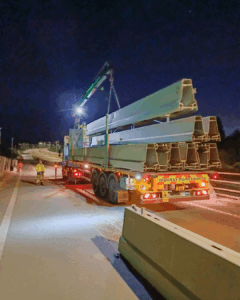
Barrier systems influence how safely maintenance teams, recovery operators and emergency services carry out their roles.
Deflection, working space and access arrangements affect how long people are exposed to traffic and how effectively incidents are managed. Where these factors are not considered at the design stage, risk is transferred to those working on the network.
A safety-led approach considers vehicle containment alongside the needs of those responsible for keeping roads open and safe.
Real-world example: Integrated System Protection
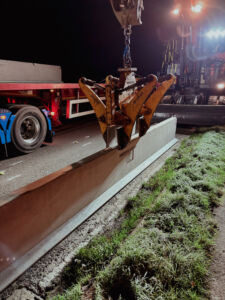
Consider the Ermes P4 crash cushion and end terminal paired with the BG800® temporary steel barrier deployed on the M5 J26 maintenance scheme.
This 6-month scheme requires lane closures that change over the duration of the project. It also includes day and night working. The combination of the Ermes and BG800 demonstrates systems-based thinking in action; the Ermes provides the energy absorption, whilst the BG800 provides steel barrier protection with controlled deflection.
Together, they create a safety system that addresses both impact protection and controlled vehicle redirection. This integration protects road users and road workers.
A systems-based approach to better outcomes
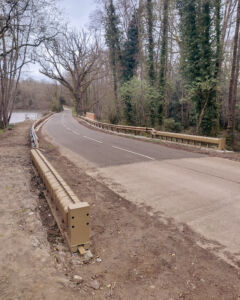
The key message here is that improved safety outcomes come from treating barriers as part of an integrated system.
This means giving equal attention to interfaces and transitions. Designing with maintenance and repair in mind and being realistic about the constraints of the existing network.
It also means applying engineering judgement alongside standards, particularly where conditions are complex or non-standard.
The key question?
Road safety is rarely about perfect solutions. It’s about making informed decisions that reduce risk across the whole life of the asset.
The right question is not only whether a barrier meets a standard. It is whether the system it forms a part of has been designed to perform safely in real operating conditions.
