
Choosing the right barrier material.
Steel, concrete and hybrid barrier systems all play a critical role in keeping people safer on the road network.
The right choice depends on more than compliance. It depends on location, traffic conditions, available space and how the system will be maintained over time. In this edition of our insight series, we explore how material decisions are made in practice and why context is always as important as specification.
When it comes to roadside protection, there is no single material that solves every challenge.
Steel, concrete and hybrid barrier systems each have a vital role to play across the road network. The right choice depends on context – road type, available space, traffic speed and vehicle mix, maintenance access, and programme pressures.
Material selection is not a theoretical exercise. It is a practical safety decision that affects road users, road workers and the communities around them.
Understanding the role of steel
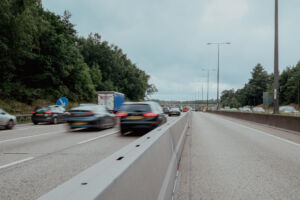 Steel barrier systems are widely used across both permanent and temporary applications. Their ability to absorb and redirect impact energy makes them well suited to environments where deflection space is available and controlled performance is required.
On live motorway and trunk road schemes, steel systems often provide the flexibility contractors need. They can be installed efficiently within tight working windows and adapted to changing site conditions. In temporary traffic management, portable steel systems such as the BG800® Portable Steel Barrier and HighwayGuard™ Portable Steel Barrier are designed to help protect operatives in high-speed motorway environments while remaining practical to deploy and recover
Steel systems do, however, require careful consideration of working width and deflection. Where space is restricted or where sensitive assets sit immediately behind the barrier, the available room for movement becomes a key factor in design.
Where concrete comes into its own
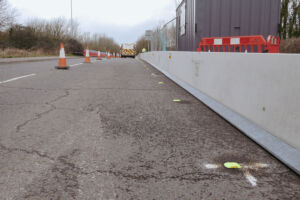 Concrete barriers are typically selected where minimal deflection is required. On narrow bridges, constrained verges or locations with limited setback, their rigidity provides containment without significant lateral movement.
They can also offer durability advantages in high-traffic environments where repeated impacts are a realistic possibility. Reduced deflection may limit damage to adjacent infrastructure and help maintain network integrity following an incident.
However, rigidity changes the nature of impact. Designers must consider vehicle mix, speed and alignment carefully. Installation logistics, lifting requirements and long-term maintenance access are also part of the decision.
As with all barrier systems, context determines suitability.
The value of hybrid approaches
Increasingly, the answer is not steel or concrete, but a considered combination of both.
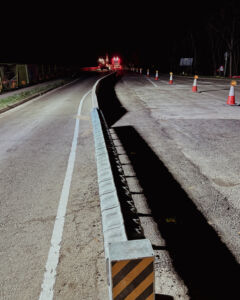
Hybrid solutions allow designers to respond to changing site conditions along a single scheme. A steel system may provide energy absorption and operational flexibility along one section, while a concrete element protects a structure or constrained area nearby.
Transitions between systems are critical; poorly designed interfaces can undermine performance. Well-designed transitions maintain containment levels and ensure the barrier system behaves as intended during impact.
Treating transitions as an afterthought introduces risk while treating them as an engineered component strengthens the whole system.
Looking beyond the moment of impact
Material choice influences more than crash performance.
Inspection regimes, repair processes and lane closure requirements all vary depending on the system installed. A barrier that requires extended repair time increases exposure for maintenance teams and can contribute to congestion-related secondary incidents.
Operational efficiency is therefore part of the safety conversation. The faster a damaged system can be assessed and reinstated safely, the sooner normal conditions can be restored.
In temporary works, the ability to deploy and recover systems efficiently can reduce the duration of workforce exposure to live traffic. In permanent installations, durability and long-term resilience affect whole-life performance and network reliability.
Designing for real-world conditions
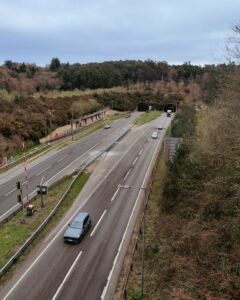 Much of the road network wasn’t built to modern-day standards. Designers are often working with constrained geometry, legacy assets and evolving traffic patterns. Heavy goods vehicle volumes, electric vehicle weights and higher traffic densities all influence how barrier systems perform over time.
Selecting the right material requires engineering judgement informed by testing standards such as EN 1317-2. Standards define performance criteria. Real-world conditions define how those systems behave in practice.
The most effective solutions are those that reflect both.
In summary
Steel, concrete and hybrid barrier systems each have strengths. None is universally superior. What matters is how well the chosen system aligns with the physical environment, operational demands and long-term safety objectives of the network.
At Highway Care, our material recommendations are guided by a single priority: ensuring the system performs where it matters most – in the conditions drivers actually face.
When decisions are grounded in context, compliance and experience, roadside protection performs as it should not only on paper, but on the road network.
